
It's not for the want of trying. Over the past couple of years I've purchased the following shelf full of books on the subject.
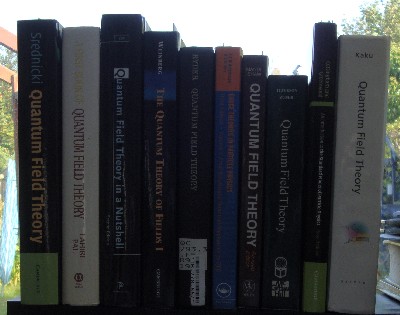
I was able to read a couple of chapters of most of them before getting lost. In some I barely managed a couple of pages. This is despite the fact that they all have their followers on Amazon who assured me that this was the book for beginners. The writing was simple, clear, direct and accessible to anyone with even the flimsiest of familiarity with basic physics. Only a completely dumb idiot could fail to understand the subject after reading this book.
I have managed to (nearly) finish one of them: Gauge Theories in Particle Physics, Volume I by Aitchison and Hey. It's taken me over a year. I've compiled a collection of notes almost as big as the book itself. One chapter alone took me over four months to get through, largely because I realised I had to reread the start of the book, and the relevant sections from several other books as well. As if that wasn't embarrassing enough, the title of the chapter begins with the word "Elementary." The authors are at pains to point out that Vol I is the easy bit and that things get much harder in Vol II.
So, partly to show off, partly to organise my thoughts and partly to pass on what little I've learned, I thought I'd try writing some of this stuff down on this blog. If I write anything that seems to contradict what real physicists say, then believe the real physicist.
To start with, I'd like to remind you all about the relevant background from Quantum Mechanics. In Classical Mechanics, the state of the system is characterised by the position and momentum of all the particles in the system. Add in the interaction forces between the particles and you pretty much have all you need to know about the system.
The position or momentum of a particle can be described by a mathematical object called a vector. Position vectors are represented by the three coordinates of a particle (x,y,z). Momentum vectors hold the mass times the speed of a particle in each of these three directions.
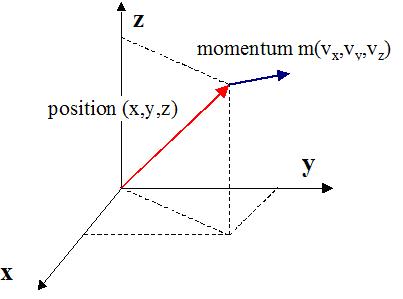
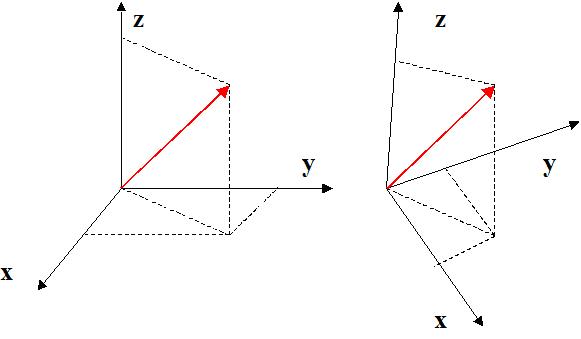
The important thing about a vector is that it isn't just any three old numbers chucked together between some brackets. In order to assign a position to a particle, I have to set up a reference frame with rulers pointing in the x, y and z directions. However, two people could set up different reference frames pointing in different directions. What's important about vectors is that the numbers that make them up transform in a very specific way when looked at from a different reference frame. In fact, we can use this as a definition: if you change your perspective and something transforms in the same way as a position vector, then that something is also a vector.
This might seem like a bit of mathematical gobbledegook, but it's very important. Being able to change the way we look at things shows us what changes and what stays the same, and its the stuff that stays the same that tells us what's important in physics.
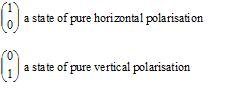
In Quantum Mechanics the state of the system is characterised by a single vector called the state vector. Just like in classical mechanics, we know how this vector transforms when viewed from different perspectives. The state vector holds all the information that there is to know about the system. The number of numbers in the state vector varies depending on what you want to know about. For example, the polarisation of a photon (a single particle of light) can be horizontal or vertical. In this case, the state vector would be represented by a pair of numbers, one each for the extent that the photon is polarised in each direction. All the other properties of the photon, it's position, momentum etc. are ignored.
If, on the other hand, you wanted to measure the position of a photon, then the state vector consists of all possible positions that the particle could take. The state vector in this case is a function.
To calculate something in Quantum Mechanics you have to know the state vector, |ψ>. (This funny looking notation for a vector was introduced by Dirac and has been the standard notation for state vectors ever since.) The next thing you need is the appropriate mathematical operator to give you the measurement you want. This might vary depending on the system. For example, the energy operator for a free particle is different from the energy operator of a particle bound inside an atom.
To get, say, the possible values for the momentum of a particle, you have to apply the momentum operator, call it P, to the state vector of the particle |ψ>. What you get back is the measurement, times the state vector |ψ>.
P |ψ> = p |ψ>
(For the mathematicians out there, the above could be either a matrix equation, if the state vector is discrete, or a differential equation, if it is a function.)
Not all state vectors have such a simple relationship with the measurement operator, but those that have are called eigenvectors. The associated set of measurements, p, are called eigenvalues. The eigenvalues of an operator are the only possible results you can get from that measurement. Very often, the eigenvalues form a discrete set of numbers - the possible values are quantised, thus the name, Quantum Mechanics.
If the state vector isn't one of the eigenvectors of an operator, then it will be some combination of the eigenvectors. Going back to our polarised particle of light, it could be in a state that is mostly horizontal, but still has some vertical polarisation.

In this case you can't say for certain what the result of a measurement will be. It will probably result in a horizontal measurement, but there is still a possibility that it will be measured as vertical.
The set of eigenvectors for different operators might not be the same. In particular, the set of states corresponding to an exact position are always completely different from the set of states corresponding to an exact momentum. If you measure a particle's position it will always adopt a state that is a combination of lots of different momenta. Conversely, if you measure its momentum, it will adopt a state that is a combination of lots of different space states. A particle simply can't be in a state of definite position and definite momentum at the same time. This is the source of the famous Heisenberg uncertainty principle.
Don't ask me why this works. AFAIK, no one knows for sure why this works. It's just that in every single situation where it's been tried, it gets the right answer.
I think that's about it for what we need to know from Quantum Mechanics. Next time I'll cover what we need from special relativity. Then, we'll be in a position to combine the two and start talking about Quantum Field Theory proper.
I was able to read a couple of chapters of most of them before getting lost. In some I barely managed a couple of pages. This is despite the fact that they all have their followers on Amazon who assured me that this was the book for beginners. The writing was simple, clear, direct and accessible to anyone with even the flimsiest of familiarity with basic physics. Only a completely dumb idiot could fail to understand the subject after reading this book.
I have managed to (nearly) finish one of them: Gauge Theories in Particle Physics, Volume I by Aitchison and Hey. It's taken me over a year. I've compiled a collection of notes almost as big as the book itself. One chapter alone took me over four months to get through, largely because I realised I had to reread the start of the book, and the relevant sections from several other books as well. As if that wasn't embarrassing enough, the title of the chapter begins with the word "Elementary." The authors are at pains to point out that Vol I is the easy bit and that things get much harder in Vol II.
So, partly to show off, partly to organise my thoughts and partly to pass on what little I've learned, I thought I'd try writing some of this stuff down on this blog. If I write anything that seems to contradict what real physicists say, then believe the real physicist.
To start with, I'd like to remind you all about the relevant background from Quantum Mechanics. In Classical Mechanics, the state of the system is characterised by the position and momentum of all the particles in the system. Add in the interaction forces between the particles and you pretty much have all you need to know about the system.
The position or momentum of a particle can be described by a mathematical object called a vector. Position vectors are represented by the three coordinates of a particle (x,y,z). Momentum vectors hold the mass times the speed of a particle in each of these three directions.
The important thing about a vector is that it isn't just any three old numbers chucked together between some brackets. In order to assign a position to a particle, I have to set up a reference frame with rulers pointing in the x, y and z directions. However, two people could set up different reference frames pointing in different directions. What's important about vectors is that the numbers that make them up transform in a very specific way when looked at from a different reference frame. In fact, we can use this as a definition: if you change your perspective and something transforms in the same way as a position vector, then that something is also a vector.
This might seem like a bit of mathematical gobbledegook, but it's very important. Being able to change the way we look at things shows us what changes and what stays the same, and its the stuff that stays the same that tells us what's important in physics.
In Quantum Mechanics the state of the system is characterised by a single vector called the state vector. Just like in classical mechanics, we know how this vector transforms when viewed from different perspectives. The state vector holds all the information that there is to know about the system. The number of numbers in the state vector varies depending on what you want to know about. For example, the polarisation of a photon (a single particle of light) can be horizontal or vertical. In this case, the state vector would be represented by a pair of numbers, one each for the extent that the photon is polarised in each direction. All the other properties of the photon, it's position, momentum etc. are ignored.
If, on the other hand, you wanted to measure the position of a photon, then the state vector consists of all possible positions that the particle could take. The state vector in this case is a function.
To calculate something in Quantum Mechanics you have to know the state vector, |ψ>. (This funny looking notation for a vector was introduced by Dirac and has been the standard notation for state vectors ever since.) The next thing you need is the appropriate mathematical operator to give you the measurement you want. This might vary depending on the system. For example, the energy operator for a free particle is different from the energy operator of a particle bound inside an atom.
To get, say, the possible values for the momentum of a particle, you have to apply the momentum operator, call it P, to the state vector of the particle |ψ>. What you get back is the measurement, times the state vector |ψ>.
P |ψ> = p |ψ>
(For the mathematicians out there, the above could be either a matrix equation, if the state vector is discrete, or a differential equation, if it is a function.)
Not all state vectors have such a simple relationship with the measurement operator, but those that have are called eigenvectors. The associated set of measurements, p, are called eigenvalues. The eigenvalues of an operator are the only possible results you can get from that measurement. Very often, the eigenvalues form a discrete set of numbers - the possible values are quantised, thus the name, Quantum Mechanics.
If the state vector isn't one of the eigenvectors of an operator, then it will be some combination of the eigenvectors. Going back to our polarised particle of light, it could be in a state that is mostly horizontal, but still has some vertical polarisation.
In this case you can't say for certain what the result of a measurement will be. It will probably result in a horizontal measurement, but there is still a possibility that it will be measured as vertical.
The set of eigenvectors for different operators might not be the same. In particular, the set of states corresponding to an exact position are always completely different from the set of states corresponding to an exact momentum. If you measure a particle's position it will always adopt a state that is a combination of lots of different momenta. Conversely, if you measure its momentum, it will adopt a state that is a combination of lots of different space states. A particle simply can't be in a state of definite position and definite momentum at the same time. This is the source of the famous Heisenberg uncertainty principle.
Don't ask me why this works. AFAIK, no one knows for sure why this works. It's just that in every single situation where it's been tried, it gets the right answer.
I think that's about it for what we need to know from Quantum Mechanics. Next time I'll cover what we need from special relativity. Then, we'll be in a position to combine the two and start talking about Quantum Field Theory proper.


